
The House
4538 Greystone Avenue is a highly picturesque residence designed to evoke a Cotswold cottage from the English countryside. Its composition is intentionally informal and richly textured, defined by rough stucco walls, irregularly shaped and steeply pitched slate roofs, and a distinctive turreted tower capped with a conical roof. The overall effect is one of warmth and permanence, with an emphasis on craft and silhouette rather than symmetry.
The home is attributed to architect R. C. Hunterby and dates to approximately 1924, a period when Fieldston’s architectural ambitions were at their height. Hunterby’s design embraces the romantic traditions of the English Arts and Crafts movement, translated through a distinctly American lens. Architectural details were deliberately expressive: the slate roof was designed with a subtle, intentional sag, reinforcing the hand-crafted character of the structure and its departure from rigid formality.
Architectural historian Andrew Scott Dolkart, Professor of Historic Preservation at Columbia University’s Graduate School of Architecture, Planning and Preservation, has described the house as featuring “a turreted tower and a steeply pitched slate-covered roof with a deliberate sag,” calling it “one of the most charming” homes in the neighborhood. The observation captures the spirit of the design—carefully composed, visually engaging, and deeply rooted in its historic context.
Today, the home remains a clear expression of its original intent: a residence designed not as a statement of scale, but as an enduring work of architecture—thoughtful in proportion, rich in detail, and inseparable from the character of Fieldston itself.
Today, the home remains a clear expression of its original intent: a residence designed not as a statement of scale, but as an enduring work of architecture—thoughtful in proportion, rich in detail, and inseparable from the character of Fieldston itself.
The Interior
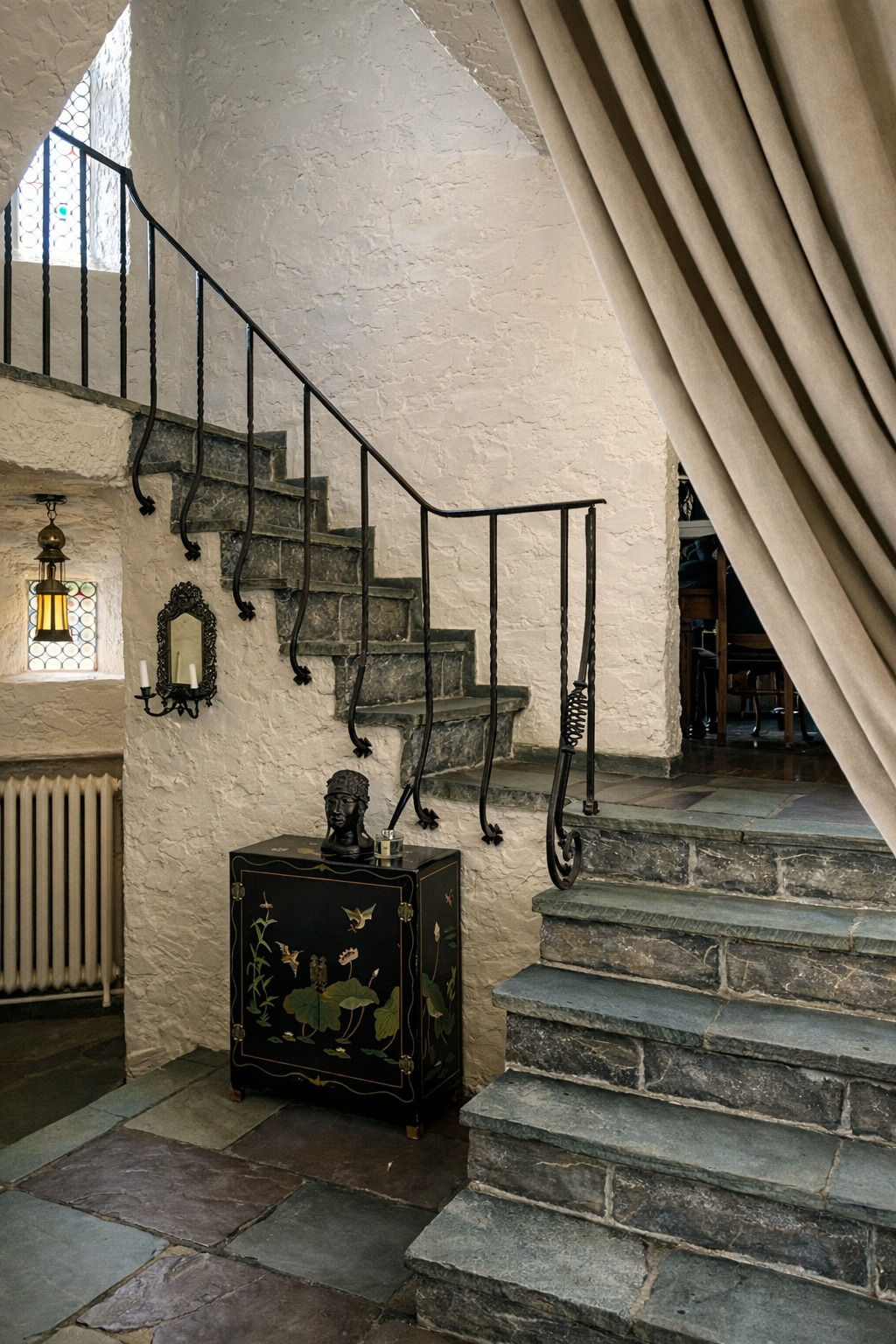
That same exterior sensibility defines the experience inside. Entry into the home is intimate and distinctly Cotswold in character, with a small sequence of slate steps leading into the main living space. The living room is anchored by a large fireplace at its far end, framed by original dark wood floors and exposed beams that immediately establish a sense of warmth and enclosure.
A short rise of a few steps leads to the second portion of the main level, where the home unfolds organically rather than formally. This level includes a cozy dining room, a mirrored bathroom with a shower and stained-glass window, and an updated kitchen equipped with modern appliances while retaining the home’s heritage aesthetic. Stained-glass windows in the kitchen overlook the garden, reinforcing the connection between interior spaces and the surrounding landscape. From the kitchen, a gentle downward transition of a few steps leads to a comfortable family den, creating a natural separation between gathering spaces without closing them off.
An elegant wrought-iron staircase leads to the second floor, which houses three bedrooms and a fully updated marble bathroom. These spaces have been thoughtfully modernized for contemporary living while remaining consistent with the home’s original character. The owner’s bedroom occupies a private position on one side of the floor, its vaulted ceiling echoing the architectural language of the living room below and creating a warm, elevated sleeping space. Two additional bedrooms are situated on the opposite side of the floor, connected by a shared hallway with updated closets.
Tucked discreetly behind an original hallway door, a pocket staircase leads to the third floor, where a fully renovated attic bedroom includes a private marble ensuite bathroom. This upper level offers a sense of retreat and flexibility, well suited for guests, work, or quiet separation from the main living areas.

The Grounds
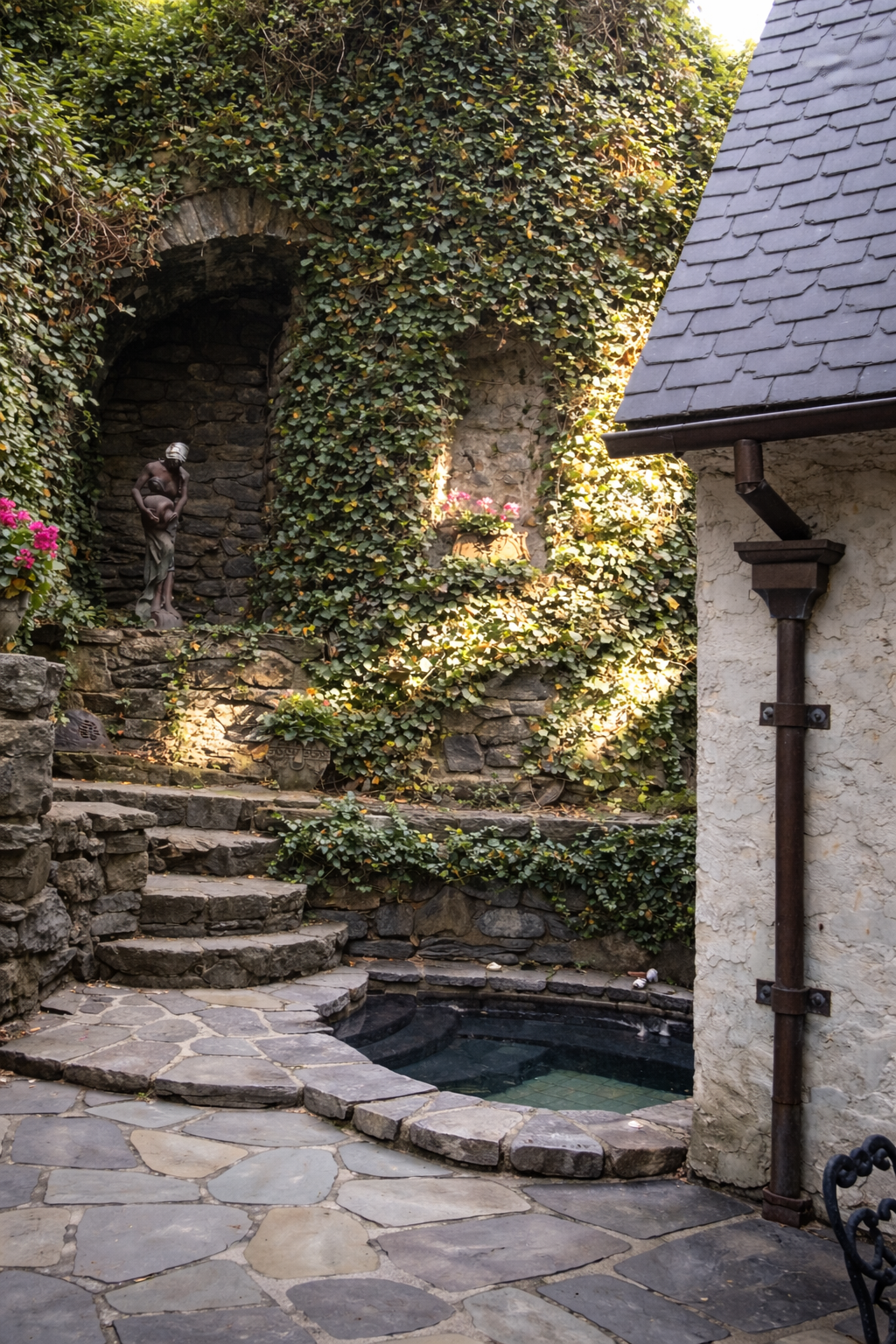
The grounds complete the home as a formal study in creating a tranquil retreat. Set at the end of a private cul-de-sac, the approach reveals a dramatic façade of stone and stucco, accented by stained-glass windows, a manicured green lawn, and a subtle English garden fountain. A gated passage connecting the carriage-house–style garage to the main residence opens into a secluded garden at the base of an exposed bedrock hillside. Here, ivy-covered stone, artfully lit inset sculptures, and natural elevation changes form a sheltered outdoor room that feels both cultivated and distinctly Fieldston.
Winding stone pathways and intimate seating areas lead from a grotto-like stone alcove past a fully modernized yet discreetly integrated in-ground jacuzzi, continuing around the home to classic English garden dining and seating spaces. Custom carved wood and hand-blown glass doors connect the garden directly to the living room, kitchen, and front approach, allowing the outdoor spaces to function equally as a private retreat and an extension of the home’s living and entertaining areas.
The grounds are anchored by an iconic exterior staircase that traces the edge of the property alongside the garage, rising more than fifty feet to connect the home to the neighboring street above—an architectural gesture that reflects both the dramatic topography of the site and the thoughtful integration of house and landscape.
Contact us
Interested in working together? Fill out some info and we will be in touch shortly. We can’t wait to hear from you!